AXM: The New Frontier of Digital Visibility
AXM: The New Frontier of Digital Visibility - Beyond SEO and Into the Age of Agent Experience Management
Executive Summary
Search is shifting from "lists of links" to synthesized answers produced by AI systems. The unit of value is no longer the click. It is inclusion: whether your brand and your facts are inside the agent's context window when an answer is generated.
In that world, winning is less about ranking a page and more about being the trusted source an agent can ingest, understand, verify, and cite. This is the role of AXM (Agent Experience Management): engineering your digital surface area so AI agents can reliably extract high-signal facts and treat your site as a source of truth.
If SEO was about being discovered by a crawler, AXM is about being usable by a reasoner.
1. The Great Decoupling: Why SEO Is No Longer the Finish Line
For two decades, SEO focused on convincing ranking algorithms that a page was authoritative for a keyword. But the user journey is decoupling from the search results page:
- Users increasingly ask a question and expect a single, synthesized answer.
- Agents increasingly decide which sources are worth reading based on cost (tokens/latency) and reliability (consensus/trust).
Shift in success criteria
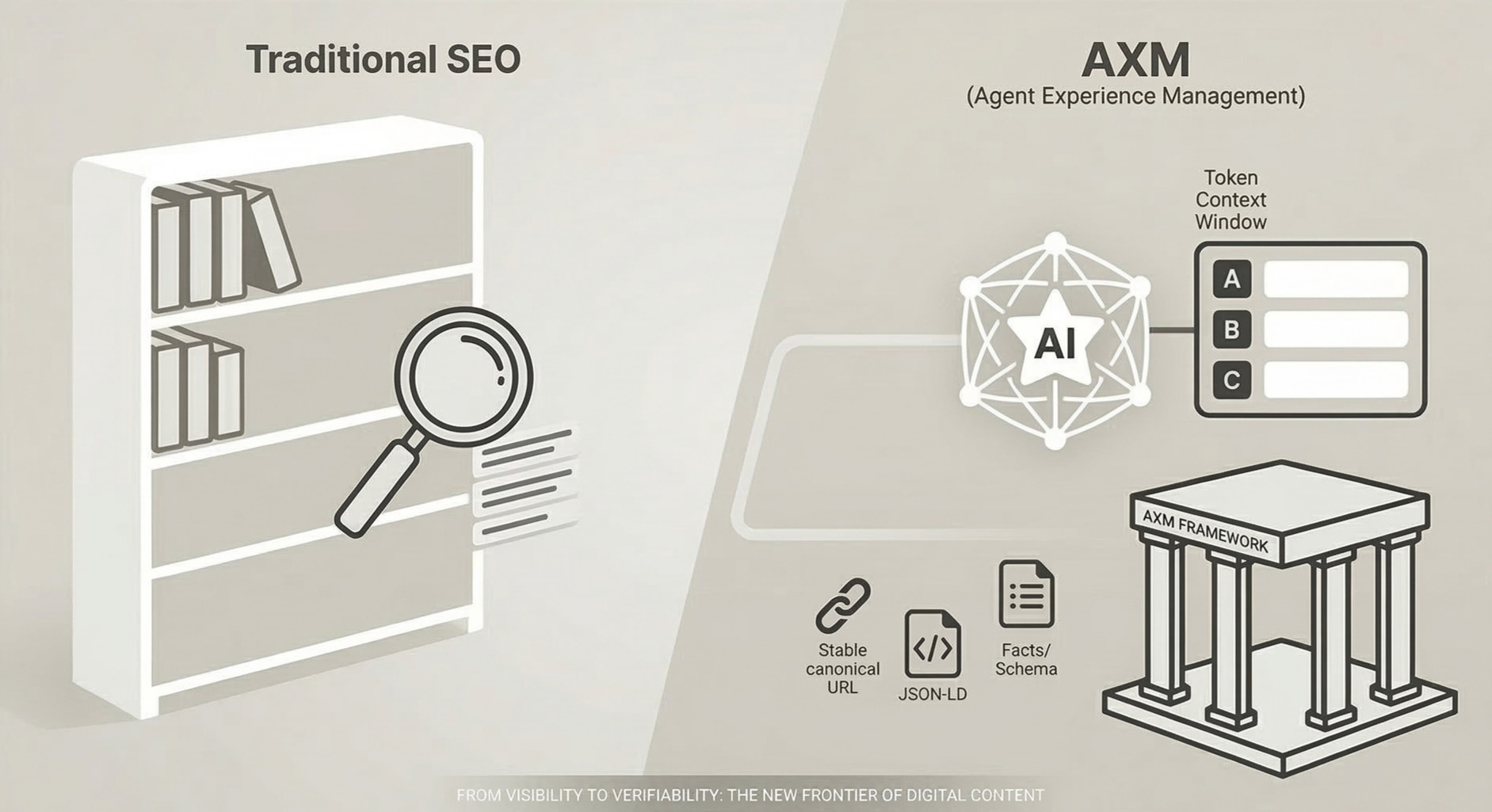
- Traditional SEO optimizes for indexing. Can a crawler discover, render, and rank the page?
- AXM optimizes for synthesis. Can an LLM agent extract the key facts quickly, trust them, and incorporate them into an answer?
If SEO is the librarian who points to a book, AXM is the analyst who reads, validates, and summarizes the book into a final report.
2. The AXM Framework: Four Pillars of Agent Interaction
At Optivor Lab, we define AXM as optimizing the "interaction lifecycle" between an AI agent and a digital asset.
I. Ingestion (Technical crawlability)
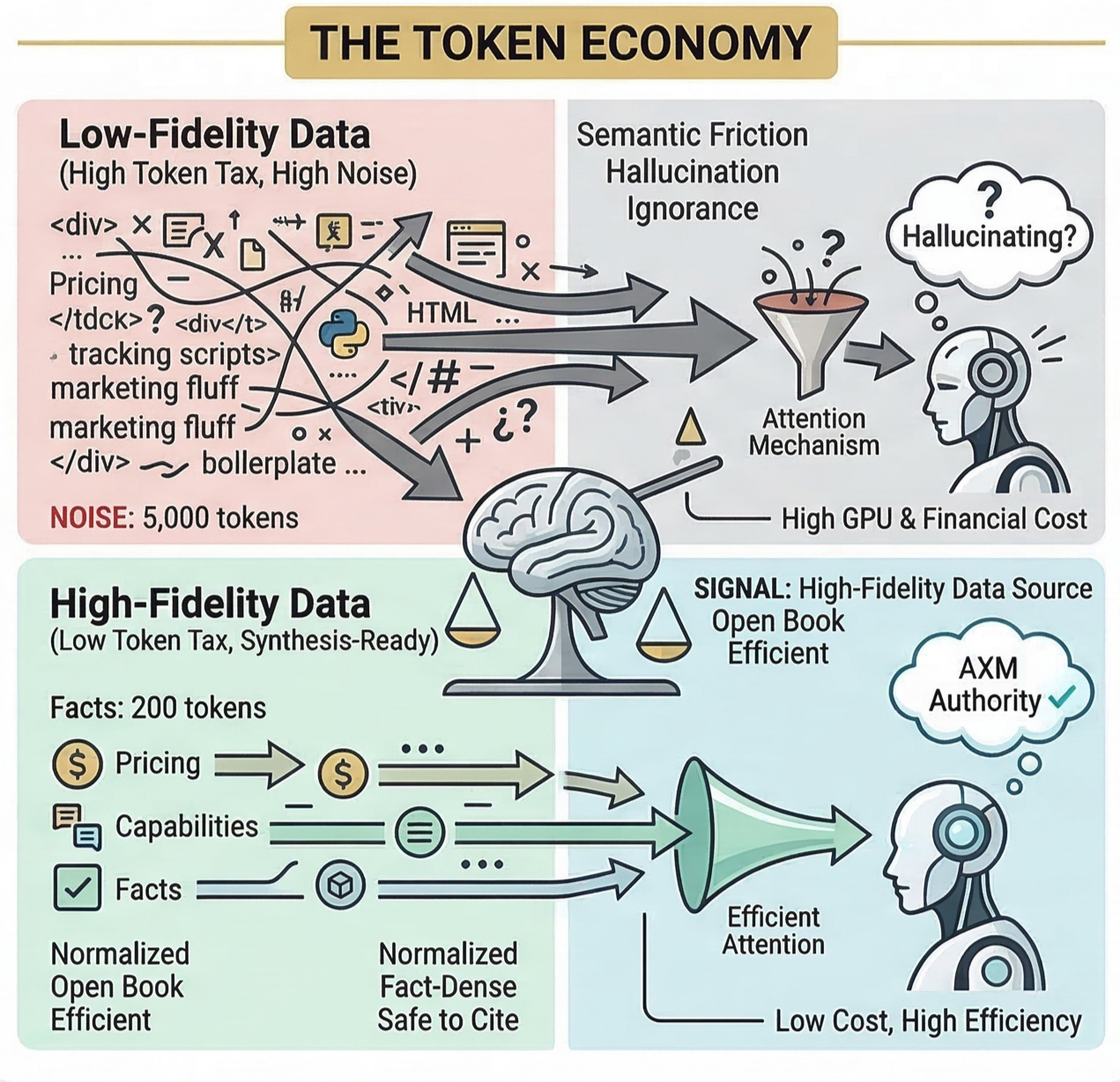
Agents have limited context windows and token budgets. In practice, they behave like cost-sensitive parsers.
AXM improves the token-to-information ratio so an agent's budget is spent on facts, not markup noise.
Signals that help ingestion:
- clean HTML with meaningful headings
- predictable URL structure
- stable canonical pages for core topics
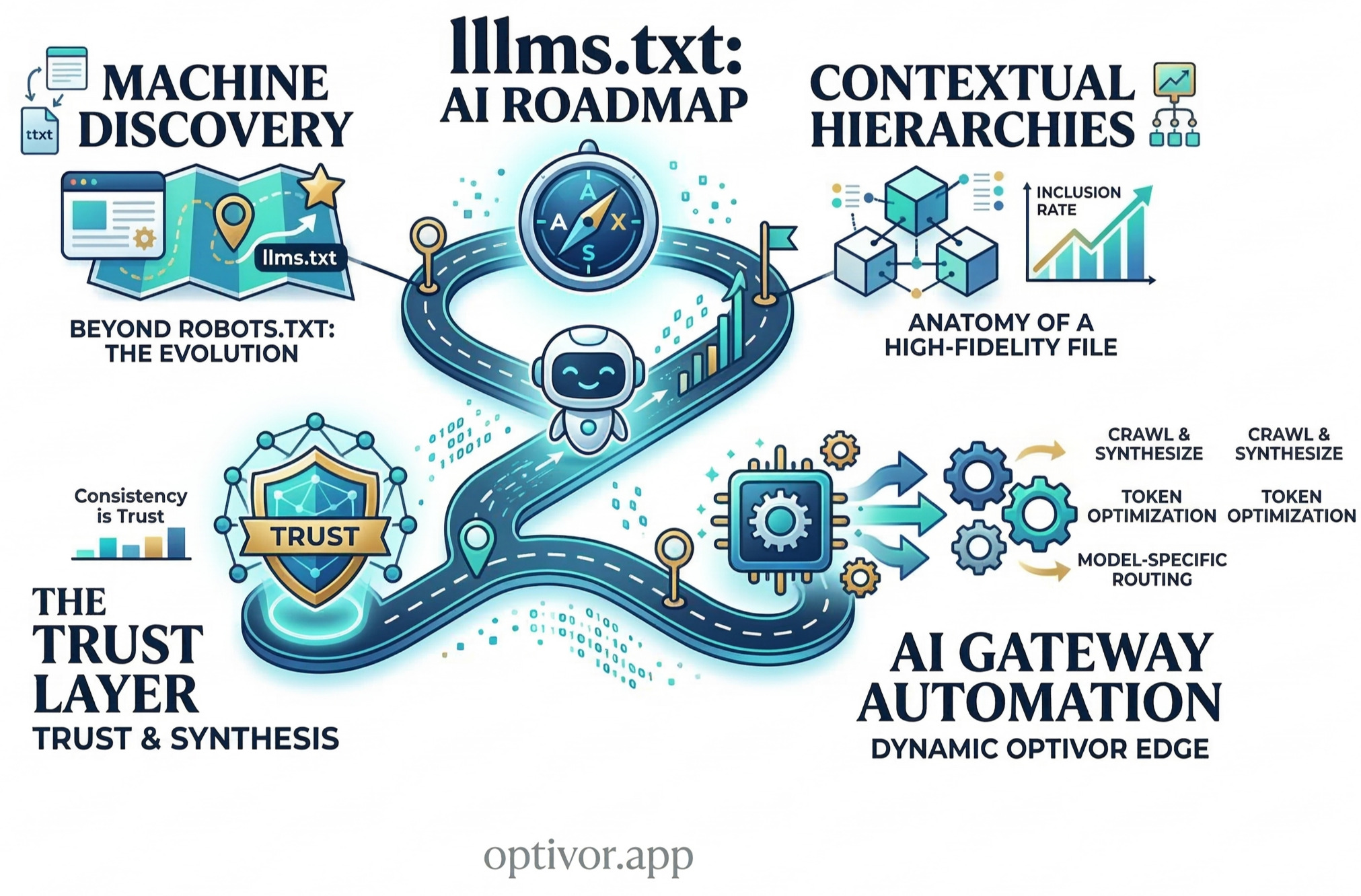
- machine-readable artifacts (e.g., JSON-LD,
llms.txt)
II. Comprehension (Semantic structure)
Agents vectorize concepts and infer relationships. Weak structure, vague headings, and inconsistent taxonomy reduce understanding confidence.
AXM favors:
- clear hierarchies (what is primary vs supporting)
- consistent terminology across pages
- explicit definitions for product terms and category names
III. Verification (Trust layer)
Before citing, agents often cross-check claims against third-party sources and known graphs. Contradictions are treated as risk.
AXM reduces contradictions by aligning:
- homepage messaging
- documentation language
- public profiles and third-party references
IV. Citation (The outcome)
The goal is to become a primary citation. When an agent says "based on data from [Your Brand]...", you've won.
Citation is not an aesthetic outcome. It is an engineering outcome: trust + extractability + consistency.
3. The Technical Friction Points That Kill AI Visibility
Through internal research, we see three common blockers.
A. The "JavaScript Wall"
Many AI agents prefer raw, static, structured data. If meaningful content is delayed behind client-side rendering, an agent may skip the page or extract partial, low-quality facts.
B. Semantic friction
If your site and public profiles describe your company differently, agents avoid citing to reduce error risk.
Examples of friction:
- different category labels for the same product
- inconsistent feature lists across marketing vs docs
- multiple "about" pages that disagree
C. Token bloat
If it takes 5,000 words to say a 500-word concept, your content becomes "expensive" for agents.
AXM prioritizes information density:
- fewer repeated claims
- tighter paragraphs
- structured sections that separate "definition" from "details"
4. Engineering the Solution: The Optivor Stack (High Level)
Optivor's approach is a zero-code AI gateway that sits between your site and AI agents.
The CNAME pattern
With a simple CNAME (e.g., ai.optivor.com), Optivor can serve agents a machine-readable representation without changing your human-facing UI.
Core capabilities
- Dynamic
llms.txtandllms-full.txt: Agent-friendly content maps that keep evolving with your site. - AI override layer: Clean, structured outputs tuned for ingestion (reduce noise, remove repetition, normalize headings).
- Agent analytics: Visibility into which models visited, what they extracted, and where citations were lost.
5. Metrics for AXM (What We Measure)
"You cannot optimize what you cannot measure."
We use three core metrics to make AXM operational:
- AI Accessibility Score (AIAS): How easy ingestion is (noise vs signal + crawl success).
- Semantic Trust Matrix (STM): How consistent and verifiable your entity is across the web.
- Agent Latency Index (ALI): Time-to-synthesis from URL -> usable answer.
These are not vanity KPIs. Each is tied to a failure mode:
- low AIAS usually means markup/JS/structure is wasting the agent budget
- low STM usually means contradictions or weak external validation
- high ALI usually means the agent is doing too much cleanup to extract facts
Conclusion: Don't Just Rank. Be the Answer.
SEO remains a foundation, but AXM is the performance layer for the agent web.
The brands that win in 2026+ will be the ones that are:
- easiest to ingest,
- hardest to dispute,
- and most efficient to cite.